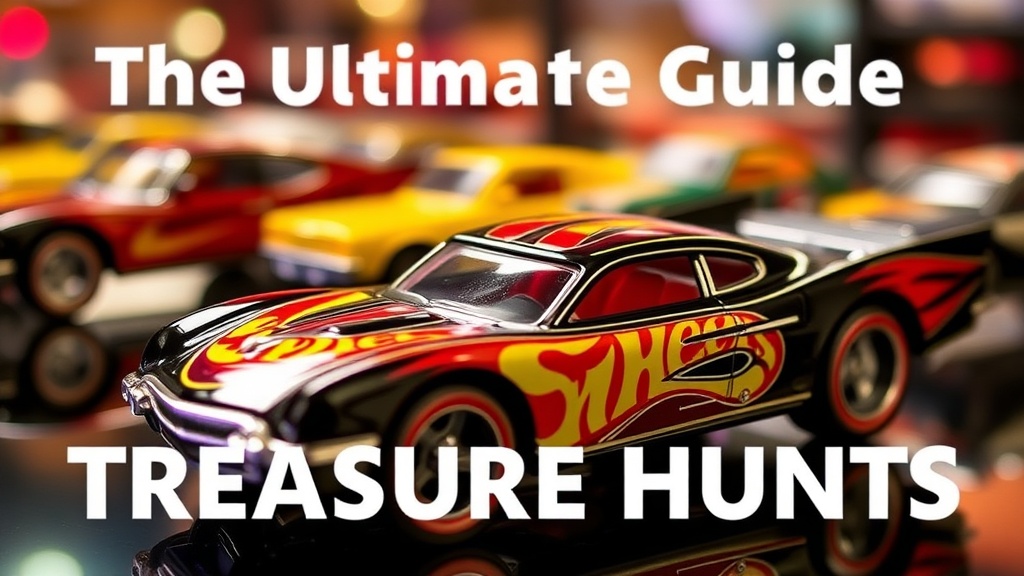
The Ultimate Guide to Finding Rare Hot Wheels Treasure Hunts

This guide covers everything needed to locate, identify, and secure rare Hot Wheels Treasure Hunt cars—the hidden gems that transform an ordinary diecast collection into something special. Whether you're hunting for the coveted Super Treasure Hunts with their rubber tires and Spectraflame paint, or trying to spot a Regular Treasure Hunt in the wild, this post breaks down the exact methods collectors use to find these elusive vehicles before they disappear from shelves.
What Are Hot Wheels Treasure Hunts and Why Do Collectors Chase Them?
Treasure Hunts are limited-production Hot Wheels cars that Mattel hides within regular case assortments. These aren't your standard $1.25 mainlines—they're deliberately scarce, often featuring premium details that set them apart. The program started in 1995 as a grassroots marketing experiment. Mattel sprinkled specially marked cars into shipments with no announcement. The buzz worked. Collectors went wild.
Today, there are two distinct tiers: Regular Treasure Hunts (often called "T-Hunts") and Super Treasure Hunts. Regular versions typically get one per case—roughly one car in every 72. Supers? One per every 15 cases. That's roughly one Super in every 1,000+ cars. The math explains the obsession.
Here's the thing—the thrill isn't just ownership. It's the chase. Finding a Super Treasure Hunt on a random Tuesday at a Walmart in suburban Ottawa feels like winning a lottery nobody else knew existed. The dopamine hit is real.
How Can You Spot a Regular Treasure Hunt vs. a Super Treasure Hunt?
The quickest way to identify a Regular Treasure Hunt is the flame logo—a circular emblem with racing flames—hidden somewhere on the car or its packaging. Sometimes it's on the hood. Sometimes it's tucked behind the rear wheel. On cardbacks, look for the text "This symbol means you just found a collectible treasure!"
Supers require sharper eyes. They feature Spectraflame paint—that deep, candy-like metallic finish that catches light differently than standard paints. The wheels are rubber (Real Riders), not the usual plastic. The base often reads "TH" somewhere. And yes, the flame logo appears too.
| Feature | Regular Treasure Hunt | Super Treasure Hunt |
|---|---|---|
| Production Ratio | 1 per case (approx. 1:72) | 1 per 15 cases (approx. 1:1,080) |
| Paint Finish | Standard enamel | Spectraflame (candy metallic) |
| Wheels | Standard plastic 5-spokes | Real Riders rubber tires |
| Price on Secondary Market | $5–$25 | $30–$300+ (varies by cast) |
| Identification Mark | Flame logo on car/card | TH base marking + flame logo |
Worth noting: Not every car in a case line-up gets the Treasure Hunt treatment. Mattel selects specific castings each year. The 2024 Supers included heavy hitters like the Custom Ford Bronco, '69 Dodge Charger Daytona, and Porsche 935. If you see Spectraflame on those castings? Grab them.
Where Are the Best Places to Hunt for Rare Hot Wheels?
Big-box retailers restock regularly—but timing matters more than location. Walmart and Target receive shipments overnight, meaning shelves get stocked between 6 AM and 10 AM most days. The early bird absolutely gets the Super. Dollar stores like Dollar Tree and Dollarama can be goldmines too, especially in smaller towns where collector competition is lighter.
Hardware stores sound weird. They're not. Canadian Tire, Home Depot, and Lowe's all carry Hot Wheels. Collectors often overlook these spots. The same goes for grocery chains—Loblaws, Sobeys, and even some Shoppers Drug Mart locations stock diecast in their toy aisles. Less foot traffic means better odds.
Here are the high-probability hunting grounds ranked by success rate:
- Walmart Supercenters — High volume, frequent restocks, multiple dump bins
- Target — Excellent case distribution, often gets exclusives
- Dollar Tree / Dollarama — Overlooked by serious hunters, great for older cases
- Canadian Tire — Underrated; stores in rural areas can hold old stock
- Pharmacy chains — CVS, Walgreens, Rexall—low competition, inconsistent stock
The catch? You can't just walk in randomly. Successful hunters build relationships with stockers. Learn delivery schedules. Some Walmarts restock Tuesdays and Fridays. Others do Monday mornings. Ask politely. Most employees don't care about Hot Wheels—they'll tell you.
What Tools and Resources Do Serious Collectors Use?
Knowledge separates hunters from finders. The Mattel Hot Wheels Collectors website publishes official case codes and Treasure Hunt lists annually. Bookmark it. The community at r/HotWheels on Reddit crowdsources real-time sightings—users post photos of fresh dumps with locations. Invaluable.
Apps matter too. Pop Price Guide tracks secondary market values for every Treasure Hunt released. Before dropping $50 on a "rare" find at a flea market, check current comps. eBay sold listings don't lie. The Hot Wheels ID app (though Mattel has sunset some features) still helps identify castings by year and series.
Facebook groups and Discord servers offer regional intel. The "Hot Wheels Canada" group specifically tracks sightings across provinces. Someone in Mississauga posts about fresh cases at their local Walmart? That's actionable intelligence if you live nearby.
When Is the Best Time to Buy Treasure Hunts on the Secondary Market?
If shelf hunting frustrates you, the secondary market offers a path—at a price. Timing purchases strategically saves money. Prices spike immediately after a Super Treasure Hunt releases. Everyone wants the new thing. Wait 6–12 months. Hype dies. Prices settle.
Convention season (February through April) floods markets with inventory. Collectors liquidate duplicates to fund new acquisitions. That's when deals appear. Watch for lots—sellers bundling a Super with common cars to move inventory. You might pay $60 for a lot where the Super accounts for $45 of the value. The commons become trade fodder.
Holiday season? Brutal. Prices jump 20–40% as gift buyers enter the market. Avoid November and December unless desperate. January brings a correction as credit card bills come due and collectors sell to recover.
What Mistakes Do Beginner Treasure Hunters Make?
Overpaying for Regular Treasure Hunts tops the list. New hunters see the flame logo, get excited, and drop $20 on a car worth $6. Research first. Not every T-Hunt commands premium prices. The 2023 Regular Treasure Hunt Morris Mini? Common. Plentiful. Worth maybe $8.
Another rookie error—ignoring card condition. A pristine Super Treasure Hunt in a damaged blister loses significant value. Serious collectors want mint cards. When hunting in the wild, carry a small protector or carefully pocket finds until you get home. Bending corners destroys resale potential.
Here's the thing about "scalpers"—the boogeyman every collector blames. Yes, some people buy cases to flip. But most stores limit purchases to 5–10 cars anyway. The real competition? Other knowledgeable collectors. The guy who checked that dump bin at 7 AM wasn't scalping. He was just earlier.
How Do You Build a Network That Helps You Find Rare Cars?
Solo hunting works. Group hunting works better. Trading communities multiply your reach. Connect with collectors who hunt different stores. You find a Ford GT-40 Super they need; they find a Custom '69 Chevy you've been hunting. Everyone wins.
Local meetups happen monthly in most major cities. Toronto, Vancouver, Calgary, Montreal—all have active diecast groups. Ottawa's scene meets quarterly at various community centers. These aren't just trading opportunities. They're information exchanges. Someone always knows which stores just restocked.
Online, follow Canadian-specific Instagram accounts. @hotwheelscanada and similar trackers post sightings with store locations. Turn notifications on. When someone posts "Fresh L case at Kanata Walmart," you've got maybe two hours before the good stuff disappears.
What Should You Do Once You Find a Treasure Hunt?
Document it. Photograph the car in the wild—on the shelf, in your hand, wherever. The community loves "in-the-wild" finds. It validates the hunt for everyone still searching. Plus, dated photos prove provenance if you ever sell.
Then decide: open or keep sealed. This debate never ends. Openers argue that diecast is meant to be handled, displayed, appreciated. Carded collectors prioritize condition and resale value. There's no wrong answer—just your preference. That said, Supers in mint condition appreciate better long-term if sealed.
Store properly. Humidity kills blister bubbles over time. Direct sunlight fades Spectraflame paint. Keep treasures in a cool, dry place. Invest in ProTech or Ultra-PRO protective cases for high-value pieces. A $3 protector preserves a $200 investment.
Final Thoughts on the Hunt
Hot Wheels Treasure Hunts represent something increasingly rare in collecting—actual scarcity at an accessible price point. Anyone can walk into a store and potentially find a $100+ car for $1.25. That democratization keeps the hobby exciting.
The best advice? Hunt consistently, not desperately. Check stores when convenient. Build relationships. Learn the patterns. And remember—it's cardboard and metal. The friendships forged trading cars at midnight in parking lots? Those outlast any collection.